Page Intro
The world before Pentecost.
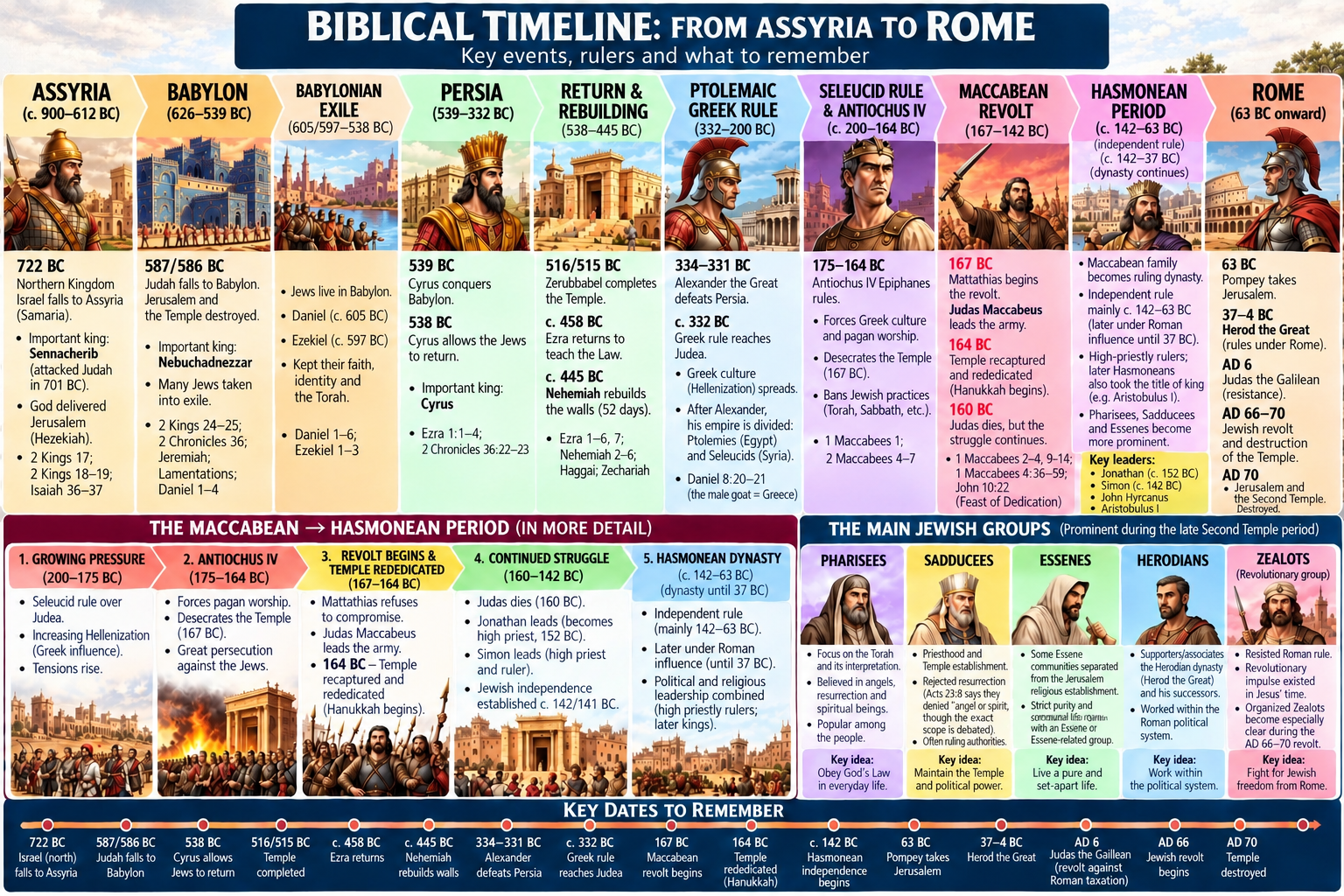
Church history does not begin in Acts 2 out of nowhere. Pentecost was the birth of the church, but the world that received the gospel had already been shaped by centuries of biblical history, foreign empires, religious debates, political tension, and deep longing for God’s promised King.
When Matthew opens, we suddenly meet Romans, Herod, Pharisees, Sadducees, synagogues, Samaritans, tax collectors, and Greek culture. If we do not understand the background, the New Testament can feel like walking into a movie halfway through. The names are there, the conflict is there, the tension is there, but we do not always know how everything got there.
This study begins before the church because the church did not appear in a vacuum. Israel had been through kings, division, exile, return, foreign domination, temple restoration, Greek influence, religious conflict, Roman power, and centuries without an independent Davidic king. Then Matthew opens with the words that change everything: Jesus Christ, the Son of David.
Church history matters because it helps us understand how the faith reached us across centuries of faithfulness and failure. The Bible is our authority. History is not our final authority. But history helps us understand the journey.
Big Idea
To understand the birth of the church, we must first understand the world Jesus entered: Israel’s history, foreign empires, Second Temple Judaism, religious groups, political pressures, and the longing for the promised King.
Key Scripture
The Scriptures behind the story.
David captures Jerusalem and makes it the political and spiritual center of Israel. God’s covenant promise to David becomes central to Israel’s hope for a future King.
Solomon builds the First Temple, but his later idolatry helps set the stage for division. After Solomon, the kingdom divides into Israel in the north and Judah in the south.
The northern kingdom falls to Assyria in 722 BC. The biblical explanation is not merely political weakness. Israel fell because of persistent covenant rebellion and idolatry.
Judah falls to Babylon in 586 BC. Jerusalem is destroyed, the Temple is burned, and the people are taken into exile. This becomes one of the greatest crises in Israel’s history.
Daniel serves under foreign kings, and Ezekiel prophesies among the exiles. Even in exile, God is not absent. He continues to speak, preserve, and promise restoration.
Persia defeats Babylon, and Cyrus allows Jewish exiles to return. The Temple is rebuilt, the Law is restored, and Jerusalem’s walls are repaired. Yet Israel is still waiting for full restoration.
The Old Testament ends with restored worship, but also spiritual apathy and corruption. Malachi promises that God will send “Elijah” before the day of the Lord. The New Testament opens with John the Baptist preparing the way.
Daniel’s visions help connect biblical prophecy with the world between the Testaments. Media-Persia, Greece, and the crisis under Antiochus IV form part of the background to the New Testament world.
Jesus is in Jerusalem during the Feast of Dedication, known today as Hanukkah. This shows that events from the intertestamental period still appear inside the New Testament.
Gamaliel mentions Judas of Galilee and the census. This connects the New Testament to revolutionary movements and political unrest under Rome.
This verse shows one major difference between Pharisees and Sadducees. Pharisees affirmed resurrection, angels, and spirits, while Sadducees rejected these.
Jesus speaks with the Samaritan woman about the dispute between Jerusalem and Mount Gerizim. He does not compromise truth, but He also does not refuse to speak with her.
Jesus sends His witnesses to Jerusalem, Judea, Samaria, and the ends of the earth. Acts 8 shows the gospel crossing old divisions and reaching Samaria.
Paul reminds believers that there is one body, one Spirit, one Lord, one faith, and one God. Our deepest identity is not our label, denomination, or tradition. Our identity is Christ.
Study Notes
From Israel’s kings to the world of Jesus.
Why Study Church History?
Church history helps us understand how Christianity reached us across twenty centuries of faithfulness and failure.
It reminds us that we did not invent the faith. We received it. People before us preached, prayed, suffered, preserved Scripture, defended truth, corrected error, planted churches, translated the Bible, discipled believers, and sometimes paid a heavy price for following Christ.
Church history also helps us discern old errors when they return with new names. Many modern problems are not actually new. False teaching, pride, division, legalism, compromise, political idolatry, dead religion, and spiritual confusion all appeared long before us.
But we must keep the order right. The Bible is our authority. History helps us understand the journey, but history does not rule over Scripture. We do not study church history to replace the Bible. We study it to understand how God has worked through real people, real places, real failures, and real faithfulness.
A Christian who knows no history can easily become arrogant. We start thinking our generation is the first one to face these questions. Church history humbles us.
Why Begin Before the Church?
Before studying Pentecost, the apostles, persecution, councils, creeds, and denominations, we need to understand the world Jesus entered.
When the New Testament opens, we meet groups and realities that are not explained from the beginning. We meet Pharisees, Sadducees, Samaritans, Herodians, tax collectors, Rome, Herod, synagogues, and Greek influence. These things did not suddenly appear overnight.
They were shaped by Israel’s long story.
Starting church history without this background is like walking into a movie forty-five minutes late. You may understand some scenes, but you will miss the weight behind the conflict. You will not fully understand why the Pharisees cared so much about tradition, why the Sadducees were connected to the Temple, why Samaritans and Jews were hostile, why Rome was hated, why tax collectors were despised, or why the people were longing for restoration.
The church was born in a world already full of religious questions, political pressure, and spiritual expectation.
That is why we begin before the church.
Israel Becomes a Kingdom
Israel’s story moves from tribal life into monarchy through Saul, David, and Solomon.
Saul becomes Israel’s first king, but his reign exposes the danger of leadership without true obedience to God. David becomes the central king in Israel’s memory because Jerusalem becomes Israel’s political and spiritual center, and God gives him covenant promises that shape messianic hope.
Solomon builds the First Temple, which becomes the central place of sacrifice and worship. But Solomon also falls into idolatry, and his failure helps prepare the way for national division.
That is a major lesson. A strong kingdom can still collapse spiritually. A beautiful Temple does not protect a people whose hearts drift from God. External success cannot replace covenant faithfulness.
Israel rises to regional power, but the seeds of division are already growing.
One kingdom would soon become two.
The Kingdom Divides
After Solomon, the kingdom divides.
The northern kingdom is called Israel, with Samaria eventually becoming its capital. The southern kingdom is called Judah, with Jerusalem as its capital. The Davidic dynasty continues in Judah.
This division is not only political. It quickly becomes spiritual.
The northern kingdom moves into idolatry and false worship. The southern kingdom preserves Jerusalem, the Temple, and the Davidic line, but Judah also struggles deeply with rebellion, injustice, idolatry, and spiritual decline.
This helps explain why the Old Testament prophets speak with such urgency. They were not giving random religious speeches. They were calling God’s covenant people back to faithfulness before judgment came.
Political division quickly became spiritual division.
That pattern still warns us today. When God’s people divide, drift, and build identity around power, tribe, personality, or convenience, spiritual compromise is never far behind.
The Northern Kingdom Falls
The northern kingdom fell to Assyria in 722 BC.
The Bible does not describe this as a random military tragedy. Second Kings 17 explains Israel’s fall as the result of persistent covenant rebellion. Israel repeatedly fell into idolatry despite the warnings of prophets like Elijah, Elisha, Amos, and Hosea.
The prophets warned. The people resisted. Judgment came.
Assyria conquered Samaria, and the northern kingdom ceased to exist as an independent kingdom. This matters because it helps explain later tensions in the land, including the complicated background of the Samaritans.
The fall of the northern kingdom teaches a serious lesson: God is patient, but He is not mocked. Religious identity without covenant faithfulness cannot save a nation. Calling yourself God’s people while worshiping like the nations leads to ruin.
Israel’s collapse was not mainly a political accident.
It was a spiritual warning.
Judah Falls to Babylon
Judah survived longer than the northern kingdom, but Judah also fell.
There were faithful kings like Hezekiah and Josiah who led reforms and called the people back toward God. Their reforms mattered, but they did not erase generations of accumulated rebellion. There were also unfaithful kings like Manasseh, who drove Judah into deep apostasy.
The prophets warned Judah too. Isaiah, Jeremiah, Micah, Zephaniah, and Habakkuk spoke into a nation drifting toward judgment.
Then in 586 BC, Babylon destroyed Jerusalem and the Temple.
This was catastrophic.
The Temple was not just a building. It represented worship, sacrifice, priesthood, and the visible center of covenant life. Jerusalem was not just a city. It was the city of David. When Jerusalem fell, the people were forced to wrestle with painful questions.
Had God abandoned them?
What happened to the promises to David?
How could worship continue without the Temple?
Where was God when His people were under foreign rule?
The exile became one of the deepest wounds in Israel’s memory.
The Exile: No King, No Temple, No Nation
The exile stripped Israel of three major realities: king, Temple, and nation.
Many Judeans lived under Babylonian rule. Daniel served under foreign kings. Ezekiel prophesied among the exiles. God’s people were scattered, humbled, and forced to live under pagan empires.
Yet God was not silent.
Even in exile, God continued promising future restoration. The longing for a Messiah, the Son of David, and the Kingdom of God became even more urgent.
This is important for understanding the New Testament. When people in the Gospels speak about the kingdom, they are not inventing a new religious idea. They are carrying centuries of hope. They are waiting for God to act, restore, redeem, judge evil, gather His people, and reign through His promised King.
Exile was not only about geography.
It created a deep spiritual hunger for restoration.
Persia and the Return
Persia defeated Babylon, and Cyrus the Great allowed Jewish exiles to return around 539–538 BC.
This fulfilled the prophetic hope recorded in Scripture. The return included several key moments: Cyrus’ decree, the rebuilding of the Temple under Zerubbabel, Ezra’s restoration of the Law, and Nehemiah’s rebuilding of Jerusalem’s walls.
This was a real act of God’s mercy.
But it was not the full restoration Israel hoped for.
They had the Temple again. They had priests. They had Jerusalem. They had Scripture. Sacrificial worship was restored. But they did not have an independent Davidic king. They were still under foreign imperial rule. Spiritual corruption remained. The prophetic hope was not fully fulfilled.
This is one of the most important points in the whole study.
Israel returned geographically, but they were still waiting spiritually and politically.
They were back in the land, but the story was not finished.
The Old Testament Ends Waiting
The Old Testament ends with waiting.
The Temple exists. Priests serve. Sacrifices continue. But Malachi confronts corrupt worship, spiritual apathy, and covenant unfaithfulness. The people are back in the land, but their hearts still need renewal.
Then Malachi promises that God will send “Elijah” before the great day of the Lord.
After that, the New Testament opens with John the Baptist, who comes in the spirit and power of Elijah to prepare the way for the Lord.
This connection matters.
The New Testament is not disconnected from the Old Testament. Matthew, Mark, Luke, and John are not starting a new religion out of nowhere. They are showing that the promises, warnings, hopes, and longings of the Old Testament are coming to fulfillment in Jesus Christ.
The Old Testament ends waiting.
The New Testament begins preparing the way.
Our Sources for the Time Between Malachi and Matthew
The Bible is our primary authority.
That must be clear. For Protestants, Scripture is the final authority for doctrine. But there are also valuable historical sources that help us understand the world between the Testaments.
Ezra, Nehemiah, Daniel, the Gospels, and Acts give us inspired biblical foundations. First and Second Maccabees provide detailed ancient history about the Greek and Seleucid crisis and the Maccabean revolt. These books are canonical for Roman Catholics and included in varying forms in Orthodox traditions, but Protestants treat them as valuable ancient literature rather than Scripture.
Josephus, a first-century Jewish historian, is another major source. He helps us understand Pharisees, Sadducees, Essenes, Hasmoneans, and Roman-era politics.
The Dead Sea Scrolls and archaeology also help reconstruct Second Temple Judaism and communities such as Qumran.
A source can be historically valuable without being our biblical authority. That distinction is important. We can learn from historical sources without placing them on the same level as Scripture.
From Persia to Greece
In 332 BC, Alexander the Great conquered the region and ended Persian dominance.
After Alexander died in 323 BC, his empire was divided among his generals. This matters because Daniel 8 identifies Media-Persia and Greece, and the political world described prophetically in Daniel becomes the historical world between the Testaments.
Greek influence spread across the conquered territories. This process is called Hellenization.
Hellenization brought Greek language, education, philosophy, athletics, names, and social customs. Some Jewish people adopted Greek culture readily. Others feared deep compromise.
This created a major question for God’s people:
How much of the surrounding culture can we accept without losing faithfulness to God?
That question did not disappear. Christians still ask it today. How much of the culture can we use, enjoy, learn from, or participate in without compromising holiness, doctrine, worship, and identity?
The background is ancient.
The question is still alive.
The Greek Kingdoms and Antiochus IV
After Alexander, Judea was caught between competing Greek kingdoms.
The Ptolemies were centered in Egypt and initially controlled Judea after Alexander’s death. The Seleucids were centered in Syria and Mesopotamia and eventually gained control of Judea.
Then came Antiochus IV Epiphanes, who reigned from 175 to 164 BC.
His rule created one of the most severe religious crises in post-exilic Jewish history. Jewish religious practices were suppressed. The Temple was desecrated. Faithfulness to Torah became dangerous.
First and Second Maccabees describe this crisis in detail. Daniel 8 and Daniel 11 are widely understood by many Christians as referring historically to Antiochus IV, though Christians differ over whether some passages also point beyond him to future events.
This period matters because it intensified Jewish concern for faithfulness, purity, Torah, Temple worship, and resistance to pagan pressure.
The crisis under Antiochus forced the question: will God’s people obey when obedience becomes dangerous?
The Maccabean Revolt and Hanukkah
In 167 BC, a Jewish priest named Mattathias refused to submit to pagan religious demands.
His son Judas Maccabeus became the defining military leader of the revolt. The Jews recaptured the Temple, purified it, and rededicated it in 164 BC.
This event is celebrated to this day as Hanukkah, the Feast of Dedication.
This history appears inside the New Testament. John 10 says Jesus was in Jerusalem during the Feast of Dedication. That means the history between Malachi and Matthew is not invisible in the New Testament. It is still there in the background.
Hanukkah reminds us that the Jewish world Jesus entered had already been shaped by suffering, resistance, temple crisis, and the longing to remain faithful under foreign power.
By the time Jesus arrives, the people are not living in a calm religious environment.
They are living inside a story of pressure, memory, and expectation.
The Hasmonean Period
The Maccabean family eventually developed into the Hasmonean dynasty.
They gained substantial political independence, but new tensions quickly emerged. Who controls the Temple? Who has legitimate priestly authority? How should Torah be interpreted? How much Greek culture is acceptable?
In this environment, groups like Pharisees, Sadducees, and Essenes became clearly identifiable.
This is important because these groups did not appear because people randomly wanted denominations. They were responding to real questions about faithfulness.
The problem was not that they believed in different gods. The problem was that they answered the same questions differently.
What does faithfulness look like under pressure?
Should we resist culture or engage it?
Who has authority to interpret Torah?
What should happen when religious leaders are corrupt?
How should God’s people respond to foreign rule?
Different answers produced different movements.
Rome Arrives
In 63 BC, the Roman general Pompey intervened in a Hasmonean power struggle and entered Jerusalem.
Jewish political independence was greatly reduced. Eventually, Herod the Great ruled Judea with Roman backing. This is why Matthew says Jesus was born in the days of Herod the king.
The New Testament begins under Roman domination, not Jewish independence.
That matters deeply.
When people are longing for the kingdom of God, they are longing under the shadow of Rome. When people speak of freedom, they are speaking under occupation. When tax collectors appear in the Gospels, they are tied to a hated system. When revolutionary movements arise, they are reacting to foreign domination.
Jesus enters a world where religion and politics are tightly connected.
People are asking: when will God restore His people?
Then Jesus arrives.
The World Jesus Entered
The world Jesus entered was religiously divided, politically pressured, socially fractured, and full of expectation.
Religiously, Pharisees, Sadducees, and Essenes offered different visions of faithfulness. Politically, Rome, Herodian rulers, and revolutionary movements competed for power and loyalty. Socially, Jews, Samaritans, and Gentiles were separated by generations of hostility.
The expectation was everywhere.
When will God restore His people?
When will the Son of David come?
When will the kingdom arrive?
When will foreign rule end?
When will God act?
The answer came in a way many did not expect. Jesus came as King, but His kingdom was not advanced by the sword. He came to fulfill the Law and the Prophets, confront hypocrisy, forgive sinners, gather disciples, die for sin, rise from the dead, and send His witnesses to the nations.
The world was waiting for restoration.
Jesus came as the promised King.
One God, Many Groups
The deck asks a strong question: if there is one God, why were there so many groups?
That question matters because many Christians today ask the same thing about denominations.
The existence of different groups does not prove there is no truth. It proves human beings disagree about truth, authority, interpretation, power, culture, and practice.
In Second Temple Judaism, the groups were not all the same type of group. Pharisees, Sadducees, and Essenes were religious movements. Herodians and revolutionary groups were political movements. Priests, Levites, and scribes were offices or roles. Tax collectors were an occupation. Samaritans were a distinct religious community, not simply another Jewish sect.
That distinction helps us read the New Testament more accurately.
Not every label was a denomination.
Not every group was a sect.
Not every person with a label believed the same thing in the same way.
History is more complex than simple categories.
The Pharisees
The Pharisees were clearly identifiable by the Hasmonean period, around the second century BC.
They were active within Jewish society in Judea and had a wide popular following among ordinary people. Their exact historical origin is debated, and the connection to the Hasideans should not be presented as certain.
The Pharisees had a strong concern for applying God’s Law to everyday life amid intense cultural pressure. They valued Scripture and inherited oral traditions as authoritative guides for faithful living. They affirmed bodily resurrection, angels, and spirits. They cared about purity, Sabbath, tithing, and holiness in daily life.
The Bible names some Pharisees specifically: Nicodemus, Gamaliel, and Paul. That matters because not every Pharisee in Scripture is presented as an evil hypocrite.
Jesus did not condemn Scripture, obedience, holiness, or serious devotion. He condemned hypocrisy, pride, self-righteousness, and human tradition overriding God’s command.
That is the real warning.
The danger of the Pharisees was not that they cared too much about God. The danger was external religion without an inwardly changed heart.
Holiness can become performance.
Devotion can become pride.
Obedience can become self-righteousness.
And when that happens, religion may look serious while the heart is far from God.
The Sadducees
The Sadducees were clearly visible during the Hasmonean period and throughout the Roman era.
They were especially associated with Jerusalem, Temple leadership, and wealthy priestly aristocratic circles. Their exact origin and the derivation of their name are historically uncertain.
Acts 23 says the Sadducees rejected bodily resurrection, angels, and spirits. They also rejected the authority of inherited oral traditions associated with the Pharisees.
We should be careful not to overstate what Scripture does not say. The New Testament does not say the Sadducees rejected every biblical book outside the Torah in the way some people casually claim. What we can say clearly is that they were strongly associated with the written Law, Temple leadership, and rejection of Pharisaic oral tradition.
Jesus confronts them in Matthew 22 when they challenge the resurrection. His answer is direct: they were mistaken because they did not know the Scriptures or the power of God.
That line is serious.
The Sadducees controlled the Temple, but they had drifted from its meaning. They had religious structure, but they lacked living faith in the God who raises the dead.
This is a warning for every generation.
You can have buildings, offices, leadership, influence, tradition, and religious language, while still missing the power of God.
Religious structure can remain while living faith disappears.
The Essenes
The Essenes were known by approximately the second century BC.
They emerged from Hasmonean-era conflict over purity, Temple leadership, and religious compromise. They became known for strict communal discipline, purity concerns, separation from the broader Jewish community, intense Scripture study, and expectation of God’s decisive intervention.
The Dead Sea Scrolls are connected to a community near the Dead Sea, often associated with Qumran. Many scholars connect Qumran with the Essenes, but the deck rightly states that this remains a strong proposal, not absolute certainty.
This matters because we should not speak more strongly than the evidence allows.
The same caution applies to John the Baptist. Some people say John was an Essene because he was in the wilderness and practiced baptism. But Scripture never says John was an Essene. Similarity is not proof of membership.
The lesson from the Essenes is powerful: separation or mission?
Some separatist communities withdrew from wider society in pursuit of purity. But Jesus remained perfectly holy while entering people’s lives. He ate with sinners, touched the rejected, entered towns, called people to repentance, and brought the kingdom near.
Biblical holiness separates us from sin, not from our mission to people.
That is the balance.
Holiness without mission becomes isolation.
Mission without holiness becomes compromise.
Jesus shows us both.
Revolutionary Movements and the Zealots
By the time of Jesus, revolutionary resistance existed in different forms.
In AD 6, when Rome introduced direct taxation and census arrangements in Judea, Judas the Galilean led active resistance. Gamaliel refers to him in Acts 5. Josephus calls the movement associated with him a “Fourth Philosophy,” emphasizing liberty and God as Israel’s true ruler, not Caesar.
The deck makes an important distinction. Revolutionary resistance existed throughout the time of Jesus, but the organized faction specifically called the “Zealots” becomes most clearly identifiable during the Jewish revolt beginning in AD 66.
So we should not assume every first-century revolutionary automatically belonged to one formal Zealot party.
The Bible calls one of Jesus’ disciples Simon “the Zealot.” But Scripture does not give enough information to reconstruct his full political biography. Matthew, another disciple, was a tax collector, widely viewed as a collaborator with Rome and a traitor to his people.
Think about that.
Simon and Matthew carried sharply different social identities. One label suggested resistance. The other suggested collaboration. Yet both ended up following the same Lord.
Jesus became greater than their former labels.
That is still the call of discipleship.
The Herodians
The Herodians were probably supporters, associates, or political allies of the Herodian dynasty. They were not primarily a theological denomination.
In Mark 3 and Mark 12, Pharisees and Herodians cooperate against Jesus. That is striking because these groups did not naturally agree on everything. Yet they became allies against a common enemy.
That still happens.
Groups that disagree deeply can suddenly unite when they feel threatened by Jesus and His authority.
The lesson from the Herodians is clear: never allow political identity to become greater than Kingdom identity.
Politics matters. Justice matters. Leadership matters. But when political loyalty becomes stronger than loyalty to Christ, something has gone wrong.
The Herodians remind us that proximity to power can become spiritually dangerous.
Do not trade Kingdom identity for political influence.
The Samaritans
The Samaritans were older than the Jewish sects of the Second Temple period.
They were not simply another group like the Pharisees or Sadducees. Their background reaches back to the Assyrian conquest of the northern kingdom, mixed populations, and centuries of competing religious identity.
By Jesus’ time, hostility between Jews and Samaritans was centuries old.
The central dispute included worship location. Jews centered worship in Jerusalem, at the Temple on Mount Zion. Samaritans centered worship on Mount Gerizim.
This is the background to John 4, when the Samaritan woman asks Jesus about the proper place of worship.
Jesus does not say, “Everybody is right.” But He also does not refuse to speak with her. He offers truth and grace at the same time.
That is important.
We do not need to compromise truth in order to love people.
And we do not need to hate people in order to defend truth.
Jesus shows a better way. He crosses hostility, speaks truth, exposes sin, offers living water, and points worship beyond both ethnic pride and empty religion.
Not Every Label Was a Sect
The deck gives an important clarification: movement does not equal office, profession, or ethnic/religious community.
Pharisees, Sadducees, and Essenes were religious movements. Herodians and revolutionary groups were political movements. Priests, Levites, and scribes were religious offices or roles. Tax collectors were an occupation. Samaritans were a distinct religious community.
This matters because Christians sometimes flatten the New Testament world.
We read labels too quickly.
Not every priest was a Sadducee. Not every revolutionary was formally a Zealot. Not every Jewish teacher was a Pharisee. Not every tax collector had the same story. Not every Samaritan was simply a “half-Jew” stereotype.
Careful Bible study requires careful categories.
When the Bible identifies someone, we should pay attention. Nicodemus, Gamaliel, and Paul are called Pharisees. Simon is called the Zealot. Matthew and Zacchaeus are tax collectors. Zechariah is a priest. Barnabas is a Levite.
But the New Testament does not name any Essene, and it does not name a disciple as a Herodian.
That should keep us from making claims the Bible does not make.
Which Group Did Jesus Join?
The Gospels identify Jesus with none of these major parties.
He was not presented as a Pharisee, Sadducee, Essene, Herodian, or armed revolutionary. He could affirm something true in a group while correcting its errors elsewhere. He engaged them all on His own terms.
This is one of the strongest lessons in the deck.
Jesus does not fit neatly into human labels. He is not controlled by our parties, traditions, slogans, or movements. He is Lord.
To the Pharisees, He exposed hypocrisy and legalism.
To the Sadducees, He exposed unbelief and ignorance of the resurrection.
To sinners, He offered mercy and called them to repentance.
To Samaritans, He crossed hostility with truth and grace.
To Rome, He did not bow.
To revolutionaries, He did not build the kingdom by the sword.
To His disciples, He said, “Follow Me.”
That is still the call.
Before we ask which group Jesus would join, we should ask whether we are following Him.
What About Christian Denominations?
The deck connects ancient Jewish groups to a modern question: why are there so many Christian denominations?
Denominations exist for many reasons. Some reasons are theological: baptism, communion, church government, spiritual gifts, worship, predestination, human responsibility, and end-times interpretation.
Other reasons are historical: geography, language, political pressure, reform movements, revivals, human pride, and personality conflicts.
Human disagreement does not prove truth does not exist.
The textbook analogy is helpful. If five students interpret the same paragraph differently, their disagreement does not prove the paragraph has no correct meaning. The real question remains: what does the text actually say?
That is why Scripture must remain above our traditions and interpretations.
Denominations may describe some of what we believe, but our denomination did not die for us. Our tradition did not save us. Jesus did.
Unity Is Not Uniformity
Unity does not mean Christians agree on every secondary issue.
Romans 14 teaches that some disagreements should not destroy Christian fellowship. Secondary differences can be held with charity and humility.
But Galatians 1 also teaches that changing the gospel itself is not a minor disagreement. Some matters are not negotiable.
Ephesians 4 calls us to speak the truth in love.
Truth without love becomes pride.
Love without truth becomes compromise.
Truth in love leads to maturity.
This is one of the most important lessons for Christians today. We must not sacrifice truth for the sake of unity. But we also must not use truth as permission for pride, hypocrisy, hatred, or self-righteousness.
Jesus did not do either.
He held truth and love together perfectly.
Lessons From These Groups
The labels changed, but the human heart did not.
From the Pharisees, we learn not to let holiness become pride or performance.
From the Sadducees, we learn not to keep religious structure while losing living faith in God.
From the Essenes, we learn not to confuse holiness with isolation from mission.
From revolutionary movements, we learn not to make earthly political power our hope for God’s kingdom.
From the Herodians, we learn not to trade Kingdom identity for political influence.
From the Samaritans, we learn not to allow historical division to stop us from loving people.
These are not just ancient history lessons. They are mirrors.
The same dangers still exist in churches today.
We can become proud like Pharisees.
Dead like Sadducees.
Isolated like Essenes.
Political like revolutionaries.
Compromised like Herodians.
Bitter like divided communities.
That is why we need Jesus, not just better labels.
The King Has Come
Israel had passed through kings, national division, exile, foreign empires, temple destruction, temple restoration, Greek rule, Roman rule, and centuries without an independent Davidic king.
Then Matthew opens with Jesus Christ, the Son of David.
That phrase is not random. It is loaded with history.
After centuries of waiting, Matthew introduces Jesus as the promised King. He is the One Israel’s story was moving toward. He is the Son of David, the true King, the fulfillment of promise, and the One greater than every label.
This is why the background matters.
When Jesus comes, He is not stepping into an empty stage. He is stepping into the long story of Israel, carrying the promises of God to fulfillment.
The King has come.
From Jesus to Pentecost
The birth of the church was not an accident.
Jesus taught, healed, called disciples, preached the kingdom, died on the cross, rose from the dead, gave the Great Commission, ascended to the Father, and promised the Holy Spirit.
Then Pentecost came.
The church was born from everything Jesus had accomplished, commissioned, and promised. Acts 2 is not a random spiritual event. It is the next step in God’s redemptive plan.
The church begins because the King has come, the cross has accomplished atonement, the resurrection has conquered death, the commission has been given, and the Spirit has been poured out.
The church is not man’s idea.
It is Christ’s body, formed by the Spirit, sent with the gospel.
The Gospel Crosses the Old Divides
Acts 1:8 says the disciples will be witnesses in Jerusalem, Judea, Samaria, and to the ends of the earth.
That order matters.
The gospel starts in Jerusalem, but it does not stay there. It moves into Judea, then Samaria, then the nations.
Acts 8 records the gospel reaching Samaria. People separated from Jewish believers by generations of hostility are brought into the same gospel, the same Lord, and the same body.
The old divides were real.
The gospel was greater.
That is still the message of the church. Jesus does not erase truth to create shallow unity. He creates true unity through Himself.
He saves Jews and Samaritans.
He saves tax collectors and zealots.
He saves men and women.
He saves rich and poor.
He saves people from every nation.
The gospel is greater than the labels that once divided us.
Why This Matters
The labels changed, but the human heart did not.
This study matters because many Christians read the New Testament without understanding the world behind it.
We see Pharisees, Sadducees, Samaritans, Herodians, Rome, tax collectors, and revolutionary language, but we do not always know where those tensions came from. When we understand the history, the Gospels become clearer. Jesus’ words become sharper. The conflicts become more meaningful. The birth of the church becomes more powerful.
This study also matters because our own generation is not as different as we think.
We still argue about culture, tradition, Scripture, politics, authority, worship, purity, mission, and unity. We still build labels. We still confuse party loyalty with faithfulness. We still struggle to speak truth in love. We still divide over secondary matters and sometimes compromise primary matters.
Church history helps us slow down and see the bigger picture.
The Pharisees warn us about pride.
The Sadducees warn us about dead religion.
The Essenes warn us about isolation.
The revolutionaries warn us about political hope replacing kingdom hope.
The Herodians warn us about power.
The Samaritans remind us that old wounds can last for centuries, but Jesus is greater.
Most of all, this study matters because it points us to Christ. Jesus is not one more label. He is Lord. Our denomination may describe part of what we believe, but it did not die for us. Our tradition did not save us. Jesus did.
Common Questions
Questions about the world Jesus entered.
Why start church history before Acts 2?
Because Acts 2 happens inside a world already shaped by Israel’s history, exile, foreign empires, Second Temple Judaism, Rome, and messianic expectation. Pentecost makes more sense when we understand the road that led there.
Why were there so many Jewish groups if they believed in one God?
They disagreed over how to be faithful under pressure. They wrestled with Torah, tradition, Temple authority, Greek culture, Roman rule, purity, resurrection, and politics. Different answers produced different movements.
Were the Pharisees all hypocrites?
No. The New Testament names Pharisees such as Nicodemus, Gamaliel, and Paul. Jesus condemned hypocrisy, pride, and tradition overriding God’s command, but He did not condemn Scripture, obedience, or serious devotion.
What did the Sadducees believe?
They were associated with Jerusalem, the Temple, wealthy priestly circles, and rejection of resurrection, angels, and spirits. They rejected Pharisaic oral tradition. We should be careful not to claim more than Scripture and history clearly support.
Was John the Baptist an Essene?
Scripture never says John was an Essene. There are similarities between John and some wilderness/purity movements, but similarity is not proof of membership. We should not present speculation as fact.
Were the Zealots already a formal party in Jesus’ day?
Revolutionary resistance existed during the time of Jesus, but the organized faction called the Zealots becomes most clearly identifiable during the Jewish revolt beginning in AD 66. Simon is called “the Zealot,” but Scripture does not give his full political biography.
Who were the Herodians?
They were probably supporters, associates, or political allies of the Herodian dynasty. They were not mainly a theological denomination. In the Gospels, they cooperate with Pharisees against Jesus.
Who were the Samaritans?
The Samaritans were a distinct religious community with roots connected to the Assyrian period and centuries of competing identity with the Jews. They worshiped on Mount Gerizim, while Jews centered worship in Jerusalem.
Did Jesus join any of these groups?
No. The Gospels identify Jesus with none of the major parties. He engaged them all, affirmed truth where appropriate, corrected error where necessary, and called people to follow Him.
What does this teach us about denominations today?
Human disagreement does not prove truth does not exist. Some differences are secondary and should be handled with humility. But changing the gospel is not a minor issue. Unity must be built on truth and love.
Discussion Questions
Questions for group study or personal reflection.
- Why is it important to understand the world before the church was born?
- What part of Israel’s history helps you understand the New Testament better?
- Why did exile create such deep longing for the Messiah and the kingdom?
- How did Greek culture create pressure for Jewish faithfulness?
- Which group do you think Christians today most easily resemble: Pharisees, Sadducees, Essenes, revolutionaries, Herodians, or Samaritans?
- Can someone be doctrinally correct and still behave unlike Jesus?
- What is the difference between holiness and performance?
- What is the difference between holiness and isolation?
- Why is political identity so dangerous when it becomes greater than kingdom identity?
- How did Jesus show both truth and grace to the Samaritan woman?
- Which doctrines are too central to the gospel to treat as minor disagreements?
- What should unite believers from different denominations?
Personal Application
Examine your labels. Follow Christ.
This study asks us to examine our labels.
Ask yourself honestly: do I find my deepest identity in Christ, or in my group, tradition, denomination, politics, culture, or personality? Do I use truth as permission for pride? Do I use love as an excuse for compromise? Do I care more about being right than becoming like Jesus?
Then look at the ancient groups as mirrors.
Am I like the Pharisees, serious about holiness but tempted toward pride and performance?
Am I like the Sadducees, keeping religious structure while losing living faith in the power of God?
Am I like the Essenes, wanting purity but forgetting mission?
Am I like revolutionary movements, hoping political power will accomplish what only God’s kingdom can do?
Am I like the Herodians, willing to trade spiritual conviction for influence?
Am I like the Jews and Samaritans, carrying old hostility instead of letting Jesus lead me into truth and grace?
This week, let church history humble you. You are not the first believer to wrestle with culture, politics, interpretation, division, and faithfulness. Learn from those who came before us. Keep Scripture as your authority. Hold truth with love. Reject pride. Refuse compromise. And remember this clearly: your tradition did not save you. Your denomination did not die for you. Jesus did.
Related Resources
Keep studying with context.
Further Reading / Sources Consulted
Scripture and historical background.
Biblical Sources
Second Samuel 5–7 gives the background to David, Jerusalem, and the Davidic covenant. First Kings 5–8 describes the building of the First Temple, while First Kings 11–12 explains Solomon’s decline and the division of the kingdom.
Second Kings 17 explains the fall of the northern kingdom to Assyria in 722 BC as the result of covenant rebellion. Second Kings 24–25, Second Chronicles 36, Jeremiah, and Lamentations explain the fall of Judah, the destruction of Jerusalem, and the Babylonian exile.
Daniel 1–6 and Ezekiel 1:1–3 show faithful witness and prophetic ministry during exile. Ezra 1–6 and Nehemiah explain the return from exile, the rebuilding of the Temple, the restoration of the Law, and the rebuilding of Jerusalem’s walls. Malachi 1–4 shows the spiritual condition at the end of the Old Testament and the promise of a coming Elijah-like messenger.
Daniel 8 and Daniel 11 help connect biblical prophecy with the Greek and Seleucid crisis between the Testaments. John 10:22 shows Jesus attending the Feast of Dedication, connecting the New Testament world with the Maccabean period. Acts 5:37 mentions Judas of Galilee and the census, connecting Acts with revolutionary movements under Rome.
Acts 23:8 explains one important difference between Pharisees and Sadducees. John 4:19–24 gives Jesus’ conversation with the Samaritan woman and the worship dispute between Jerusalem and Mount Gerizim. Acts 1:8 and Acts 8 show the gospel crossing old divides and reaching Samaria. Ephesians 4:4–6 teaches that believers share one body, one Spirit, one Lord, one faith, and one God.
Historical Sources Named in the Deck
First and Second Maccabees are valuable ancient sources for the Greek and Seleucid crisis, the persecution under Antiochus IV, the Maccabean revolt, and the rededication of the Temple. Protestants do not treat these books as final biblical authority, but they are historically valuable for understanding the world between Malachi and Matthew.
Josephus is a first-century Jewish historian and an important source for Pharisees, Sadducees, Essenes, Hasmoneans, Herodian politics, and Roman-era Jewish history. His writings must be read critically, but they remain historically significant.
The Dead Sea Scrolls and archaeology help reconstruct Second Temple Judaism, Jewish Scripture transmission, sectarian communities, purity concerns, and the world near Qumran. Many scholars connect Qumran with the Essenes, but this should be presented as a strong proposal rather than certainty.
Unashamed Faith Deck Consulted
Unashamed Faith teaching deck consulted: Before the Church — Church History Part 1: How Israel’s history, foreign empires, theology, tradition, and politics shaped the world of Jesus.